
 +91-9811-911-675
 Email Us
Beyond the “One-Size-Fits-All” Approach to BRCA and Ovarian Cancer Prevention
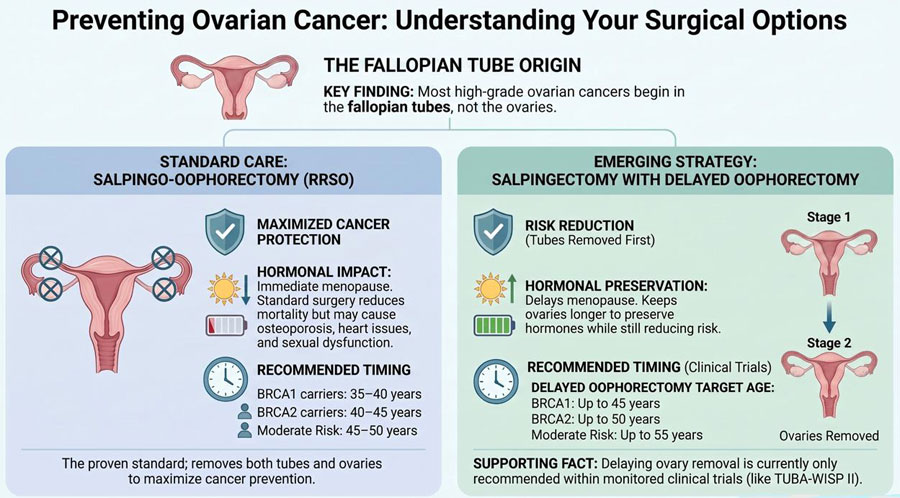
For women who test positive for a BRCA1 or BRCA2 pathogenic variant, the shadow of cancer risk can feel all-consuming. Tubo-ovarian cancer remains the most lethal gynecological malignancy, primarily because there is currently no effective screening method to detect it in its early, curable stages.
Historically, the recommendation was straightforward: remove the fallopian tubes and ovaries (risk-reducing salpingo-oophorectomy or RRSO) as soon as childbearing was complete. However, today’s landscape is shifting. We are moving toward individualized risk assessment—a personalized path that balances life-saving prevention with your long-term quality of life.
Case Scenario: Balancing Risk and Reality
Archana, a 35-year-old whorecently underwent germline testing and was found to have BRCA1 mutation, finds herself at a crossroads. Current guidelines recommend she undergo RRSO between the ages of 35 and 40. While she is committed to preventing cancer, she is deeply concerned about surgical menopause.
As a premenopausal woman, the sudden loss of estrogen from removing her ovaries could lead to immediate vasomotor symptoms (hot flashes), sexual health challenges, and long-term risks like decreased bone mineral density and cardiovascular issues. Archana wonders if her specific risk—given her lifestyle and the fact that her only affected relative was diagnosed at age 60—allows for a more tailored timing of her surgery.
The Power of Personalized Risk Assessment
We now know that tubo-ovarian cancer risk is not uniform for every BRCA carrier. It is influenced by the specific type of mutation, family history, and “modifiable” factors like oral contraceptive use, parity (number of births), and breastfeeding.
To help women like Archana, we use advanced tools like the Can Risk (BOADICEA) platform. This tool integrates:
- Genetic Profile: The specific variant and its location on the gene.
- Family Pedigree: Detailed ages and types of cancer in relatives.
- Lifestyle Factors: BMI, history of tubal ligation, and reproductive history.
By using these models, a specialist can provide a recalibrated lifetime risk estimate, helping you and your care team determine the optimal “risk trajectory” for your surgery.
Exploring the Fallopian Tube Connection
Groundbreaking research has shown that many high-grade serous carcinomas actually originate in the fallopian tubes rather than the ovaries. This has led to the exploration of a two-step surgical approach: risk-reducing salpingectomy with delayed oophorectomy (RRSDO).
In this strategy, the fallopian tubes are removed early to reduce cancer risk, while the ovaries are left in place to preserve natural hormones until a later age. It is critical to understand that RRSDO is currently only recommended within clinical trials (such as TUBA-WISP II, SOROCk, or PROTECTOR) while researchers confirm its long-term safety compared to the standard RRSO.
Why You Must See a Gynecological Oncologist
Navigating these options requires more than a standard check-up. Because the science of hereditary cancer prevention is evolving so rapidly, meeting with a gynecological oncologist is essential.
A gynecological oncologist provides:
- Expert Counseling: Translating complex genomic data into a practical framework for your life.
- Clinical Trial Access: Identifying if you are a candidate for cutting-edge studies investigating delayed oophorectomy.
- Comprehensive Care: Managing the transition into menopause, including monitoring bone health and discussing hormone replacement therapy.
Conclusion Your BRCA status is a powerful piece of information that allows you to take control of your health. However, the path you take should be as unique as your genetic code. Schedule a consultation with a gynecological oncologist today to discuss your personalized risk-reduction strategy and ensure you are making the most informed decision for your future.
Category: Ovarian Cancer
Categories
Recent Posts
- Beyond the “One-Size-Fits-All” Approach to BRCA and Ovarian Cancer Prevention
- Life After Gynecological Cancer: Navigating the “Sudden Menopause”
- How Fast Does Oral Cancer Spread? A Simple Guide by Dr. Ravi Shankar
- Ovarian Cancer Surgery in India: Complete Guide for Patients
- Thyroid Cancer Diet: 5 Essential Tips for Faster Recovery – By Dr. Ravi Shankar